Aseptic Cleanroom HVAC Design & Differential Pressure Cascades in Injectable Sterile Facilities
A master engineering analysis on designing HVAC air cascades, terminal HEPA filtration, and differential pressure regimes (+15 Pa) to maintain ISO Class 5 / Grade A sterility without cross-contamination.
✓Key Engineering Milestones & Standards
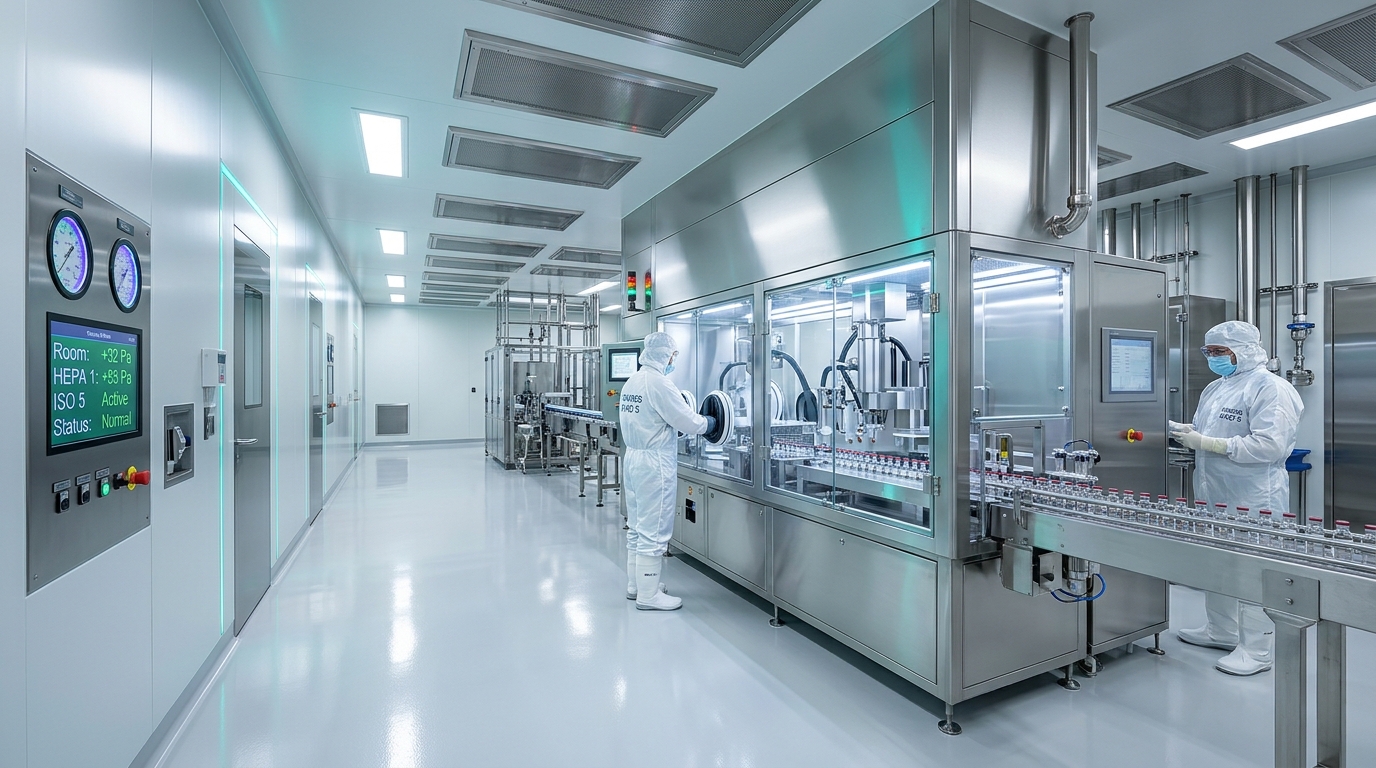
- Cascade philosophy: Differential pressure (+15 Pa delta between adjacent cleanliness classes) acts as an invisible barrier preventing ingress of viable and non-viable particulates.
- Unidirectional laminar airflow in Grade A filling cores maintained at 0.45 m/s ± 20% at working height with CFD-verified velocity sweeps.
- Terminal ceiling HEPA (H14 / 99.995% efficiency) filters fitted with integral fluid-gel seal channels and upstream PAO challenge test injection ports.
- Dedicated supply and return air risers with low-level return air grilles (150mm above finished floor) to continuously sweep settling particles away from aseptic surfaces.
- Full compliance with ISO 14644-1/2, EU GMP Annex 1 (2022 revision), and US FDA 21 CFR Part 211 sterile manufacturing mandates.
In sterile injectable manufacturing, the HVAC and cleanroom pressurization envelope is the primary engineered barrier safeguarding parenterals, biologics, and lyophilized drugs from environmental microbial contamination. Unlike standard industrial air conditioning, a pharmaceutical HVAC system must control five interconnected critical environmental variables simultaneously: airborne particulate counts, viable biological contamination, differential room pressure, temperature, and relative humidity (RH).
Under the revised EU GMP Annex 1 guidelines, cleanroom suites are classified into Grade A, B, C, and D zones. The core principle governing airflow architecture is the pressure cascade: air must flow continuously from areas of higher cleanliness to areas of lower cleanliness. In an injectable sterile filling facility, the critical filling core (Grade A) must be protected by an uninterrupted positive pressure envelope (+45 Pa relative to ambient corridor pressure), cascading down through Grade B buffer zones (+30 Pa), Grade C preparation rooms (+15 Pa), and unclassified airlocks (0 Pa).
Terminal filtration must utilize H14 HEPA or U15 ULPA filters installed directly in the ceiling envelope rather than in the remote air handling unit (AHU). This eliminates the risk of duct leakage downstream of filtration. Furthermore, modern aseptic design incorporates gel-seal filter frames to completely eradicate gasket bypass, and includes integrated differential pressure transmitters linked directly to 21 CFR Part 11 compliant Building Management Systems (BMS).
Clean and Control Technologies engineers turnkey cleanroom envelopes utilizing pharmaceutical-grade double-skinned PUF/PIR modular partition panels with flush double-glazed view panels, silicone-free polyurethane joint seals, and integrated coving with R-50 radius to eliminate dead air pockets and facilitate vaporized hydrogen peroxide (VHP) decontamination cycles.
Technical Specifications & Regulatory Parameters
| Cleanroom Zone | ISO 14644-1 Class | EU GMP Grade | Target Differential Pressure | Air Changes per Hour (ACPH) |
|---|---|---|---|---|
| Sterile Filling & Stoppering Core | ISO 5 (at rest & in operation) | Grade A | +45 Pa (Highest Core) | Unidirectional Laminar Flow (0.45 m/s) |
| Aseptic Preparation & Formulations | ISO 7 (at rest) / ISO 8 (in op) | Grade B | +30 Pa Cascade | 45 – 60 ACPH |
| Component Washing & Capping | ISO 8 (at rest) | Grade C | +15 Pa Cascade | 25 – 35 ACPH |
| Secondary Packaging & Gowning Airlocks | Unclassified / CNC | Grade D / CNC | +10 Pa to 0 Pa Baseline | 15 – 20 ACPH |
Regulatory Compliance Standard
All engineering design packages, differential pressure cascades, and qualification protocols developed by Clean and Control Technologies adhere to USFDA 21 CFR Parts 210/211, EU GMP Annex 1, WHO Technical Report Series, and ISPE Baseline Guides.
DSVKA Narasimha Raju
Managing Director & MEP Specialist, Clean & Control
Clean and Control Technologies Pvt Ltd is a premier turnkey pharmaceutical engineering, cleanroom construction, and CQV qualification consultancy headquartered in Hyderabad, India.