What is the Pharmaceutical Effluent Treatment Process? A Step-by-Step Guide
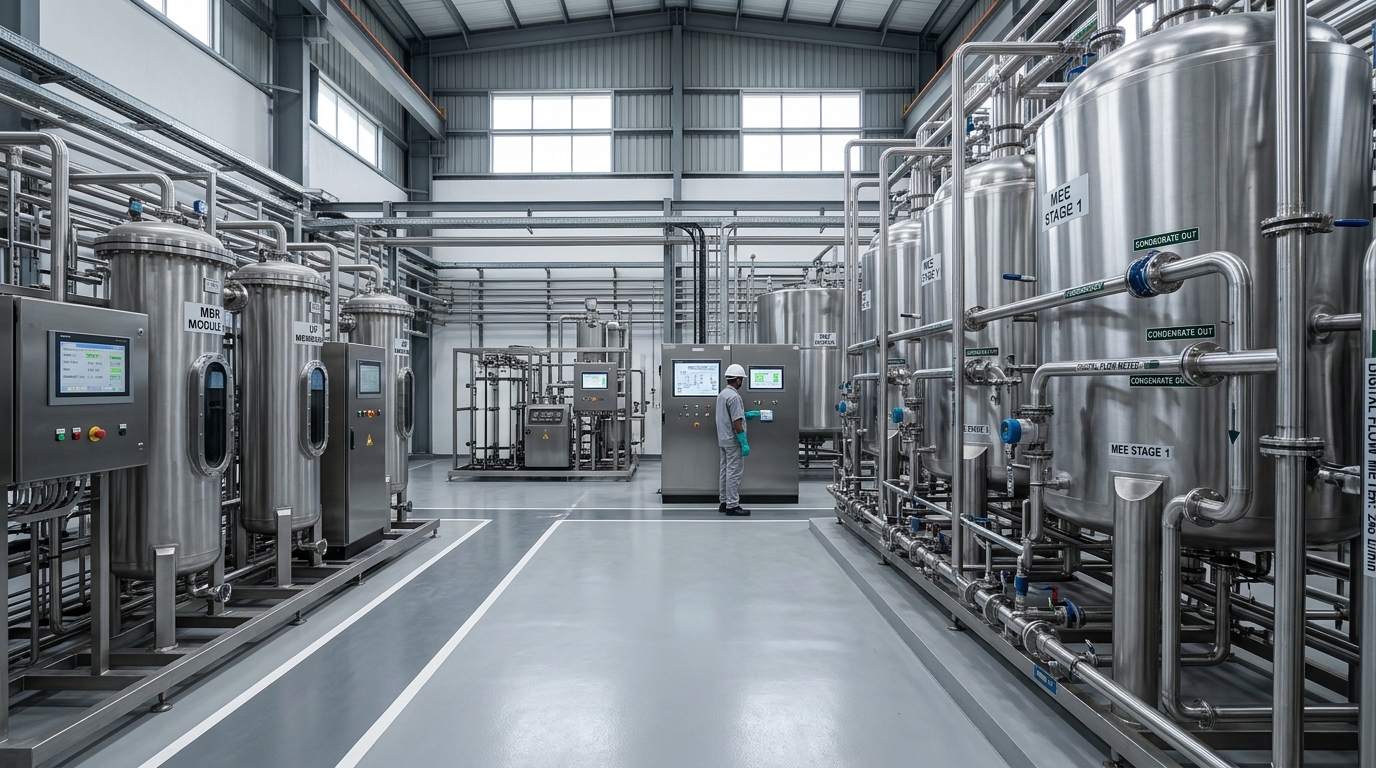
From primary equalization and neutralization to advanced biological membrane bioreactors (MBR) and Multi-Effect Evaporators (MEE) — a comprehensive engineering blueprint for achieving Zero Liquid Discharge (ZLD) in pharmaceutical manufacturing.
✓Key Engineering Milestones & Standards
- Segregation at source: High-COD/TDS process effluent streams from API synthesis must be segregated from low-load wash waters to optimize downstream treatment chemistry.
- Advanced Oxidation Processes (AOP) employing Fenton reagent and ozone destroy recalcitrant Active Pharmaceutical Ingredients (APIs) and antibiotics before biological treatment.
- Membrane Bioreactors (MBR) combining activated sludge digestion with ultrafiltration membranes consistently deliver permeate with BOD < 5 mg/L and suspended solids < 1 mg/L.
- Multi-Stage Reverse Osmosis (RO) recovers 85-90% clean water for cooling towers and boiler feed, reducing fresh utility water consumption.
- Zero Liquid Discharge (ZLD) thermal loops (Multi-Effect Evaporator + Agitated Thin Film Dryer) convert remaining brine into dry crystalline solids for secure landfill disposal.
In modern pharmaceutical bulk drug (API) and formulation manufacturing, industrial wastewater represents one of the most chemically complex effluent matrices in industrial engineering. Pharmaceutical effluents contain variable mixtures of active pharmaceutical ingredients (APIs), recalcitrant synthetic solvents, high Chemical Oxygen Demand (COD), variable Biochemical Oxygen Demand (BOD), and antimicrobial compounds that inhibit conventional biological digestion. Regulatory authorities worldwide, including the Central Pollution Control Board (CPCB) and US EPA, enforce strict Zero Liquid Discharge (ZLD) norms to prevent environmental contamination.
The treatment architecture engineered by Clean and Control Technologies follows a rigorous multi-stage hierarchy. Stage 1 begins with segregation at source: high-concentration mother liquors and solvent residues are isolated from wash waters. The streams enter primary equalization tanks equipped with submersible non-clog mixers and automated dosing loops for pH correction using lime, caustic soda, and sulfuric acid to stabilize fluctuation between pH 2.0 and 11.0. Physico-chemical primary treatment incorporates flash mixing with Polyaluminum Chloride (PAC) coagulants and high-molecular-weight polyelectrolytes, feeding into inclined lamella plate clarifiers or dissolved air flotation (DAF) units for suspended solids removal.
For streams containing biorefractory or active antibiotic residues, Advanced Oxidation Processes (AOP)—such as Fenton’s oxidation (Fe²⁺ + H₂O₂) or catalytic ozonation—generate highly reactive hydroxyl radicals (•OH) that cleave complex aromatic rings into readily biodegradable intermediates. The effluent then flows into Secondary Biological Treatment featuring an advanced Submerged Membrane Bioreactor (SMBR). By replacing conventional gravity secondary clarifiers with hollow-fiber or flat-sheet ultrafiltration membranes (0.04 µm nominal pore size), the MBR operates at high Mixed Liquor Suspended Solids (MLSS of 8,000–12,000 mg/L), achieving >98% BOD removal and complete particulate clarification.
The clarified MBR permeate advances into Tertiary Treatment: dual-media sand filters and granular activated carbon (GAC) adsorbers remove trace organics and color. The polished water is then pressurized across high-rejection spiral-wound Brackish Water Reverse Osmosis (BWRO) membranes operating in a two-stage cascade with anti-scalant dosing. The RO permeate (>85% recovery) meets ultra-pure industrial water specs and is recycled directly to utility cooling towers and boiler make-up. The concentrated RO reject is channeled into an energy-efficient Multi-Effect Evaporator (MEE) constructed in SS316L / Titanium, followed by an Agitated Thin Film Dryer (ATFD), completely converting the liquid waste into dry crystalline salts for certified disposal.
Technical Specifications & Regulatory Parameters
| Treatment Stage | Primary Technology | Inlet Parameter | Target Outlet Parameter | Regulatory Discharge Standard |
|---|---|---|---|---|
| Equalization & pH Control | Automated Dosing & Static Mixers | pH 2.0 – 11.0 | pH 6.5 – 8.5 | CPCB / MoEFCC Mandate |
| Primary Coagulation & Clarification | Flash Mixer + Lamella Settler | TSS > 1,500 mg/L | TSS < 250 mg/L | > 80% Solids Reduction |
| Advanced Biological MBR | Submerged Ultrafiltration (0.04 µm) | BOD > 3,500 mg/L, COD > 8,000 mg/L | BOD < 10 mg/L, COD < 100 mg/L | Complete Bacterial Retention |
| Tertiary Polishing & RO | Dual-Media + Two-Stage BWRO | TDS > 5,000 ppm | Permeate TDS < 100 ppm | 85% - 90% Clean Water Recovery |
| ZLD Thermal Crystallization | Multi-Effect Evaporator (SS316L) + ATFD | RO Reject (TDS > 45,000 ppm) | Dry Bagged Salts (< 5% Moisture) | Zero Liquid Discharge (100% ZLD) |
Regulatory Compliance Standard
All engineering design packages, differential pressure cascades, and qualification protocols developed by Clean and Control Technologies adhere to USFDA 21 CFR Parts 210/211, EU GMP Annex 1, WHO Technical Report Series, and ISPE Baseline Guides.
G. Venkateswara Rao
Director & Environmental Engineering Lead, Clean & Control
Clean and Control Technologies Pvt Ltd is a premier turnkey pharmaceutical engineering, cleanroom construction, and CQV qualification consultancy headquartered in Hyderabad, India.